Vietnam’s Conditional Business Line Reform: Easier Entry, Tougher Audits
10/06/2026
Among the headline changes in Vietnam’s Law on Investment No. 143/2025/QH15 — effective March 1, 2026 — the restructuring of conditional business lines may have the most immediate operational impact for foreign service-sector investors. The new Appendix IV eliminates 38 conditional lines and adjusts the scope of 20 others versus the prior list of approximately 227. From July 1, 2026, the conditional list contracts further to roughly 198 sectors. The regulatory philosophy is a deliberate one: easier to enter, harder to operate carelessly.

What Came Off the List
Among the 38 lines removed from conditional status, several stand out for their relevance to foreign-invested service businesses:
- Tax procedure services — previously requiring a specific professional license
- Customs brokerage services — no longer pre-licensed
- Insurance auxiliary services — loss adjusting, actuarial work, insurance consulting
- Labor outsourcing — a meaningful B2B service category
- Commercial appraisal
- Temporary import / re-export of frozen foods and used goods
These are not obscure niches. They are the supporting professional services that the broader FDI ecosystem depends on — and ones in which many foreign-invested operators have struggled with multi-month pre-licensing delays. Removing them from the conditional list does not mean “anyone can practice.” It means professional standards apply through post-inspection rather than gatekeeping.
From Pre-Licensing to Post-Inspection
The substantive shift is captured in one Vietnamese term: hậu kiểm, or “post-inspection.” Where the old system required a license before operations could begin, the new system permits operations subject to compliance verification after the fact. Authorities still hold meaningful enforcement tools — suspension, license revocation, fines — but they apply on the back end, not the front.s
The Investment Policy Approval (IPA) net has narrowed in parallel. IPA used to apply broadly to FDI projects; it now covers only about 20 narrowly defined categories, primarily large-scale projects, those requiring special land use, or those in strategic sectors such as energy and national infrastructure. For typical service-sector and light-manufacturing FDI, IPA is no longer a hurdle.
M&A approval thresholds for non-strategic sectors have also been eased, making it materially faster to close deals involving the acquisition of existing Vietnamese companies by foreign investors.
The Connection to the IRC/ERC Reform
These changes interlock with the procedural reform that lets foreign investors obtain the Enterprise Registration Certificate (ERC) before the Investment Registration Certificate (IRC) in unconditional sectors. As the conditional list shrinks, the universe of FDI projects eligible for the faster “ERC-first” pathway expands. Decree 96/2026 implements the detail, and outbound investment approvals from Vietnam have been simplified in parallel — signaling a more flexible two-way investment framework.
Where Friction Remains
Despite the broader liberalization, certain sectors remain tightly controlled:
- Real estate trading — minimum capital requirements and licensing persist
- E-commerce platforms — heavy regulation under consumer protection and cybersecurity law
- Education — particularly international curricula and degree-granting institutions
- Healthcare — hospitals, clinics, pharmaceuticals
- Fintech — including e-wallets, peer-to-peer lending, and payment services
For these sectors, foreign investors should still plan for traditional licensing pathways and timelines of three to six months or longer.
Conclusion
The reform of Vietnam’s conditional business line regime is more than a technical amendment to investment law. It signals a broader shift from front-end market-access control toward a more flexible regulatory model: businesses may enter the market faster, but they will be expected to maintain a higher level of compliance once operations begin.
For foreign investors, the opportunity lies in speed. Service sectors that previously required months of pre-licensing may become easier to access, particularly for consulting, logistics, insurance support, labor-related services, and other FDI-facing professional activities. But the risk also lies in that same speed. The absence of an entry gate does not mean the absence of legal obligations.
In this new environment, the advantage will belong to investors who prepare their licensing files, internal controls, employment contracts, accounting, tax compliance, and professional standards from day one. Entering the market quickly is useful; remaining in the market safely and sustainably is the real long-term strategy.

 VN
VN  EN
EN 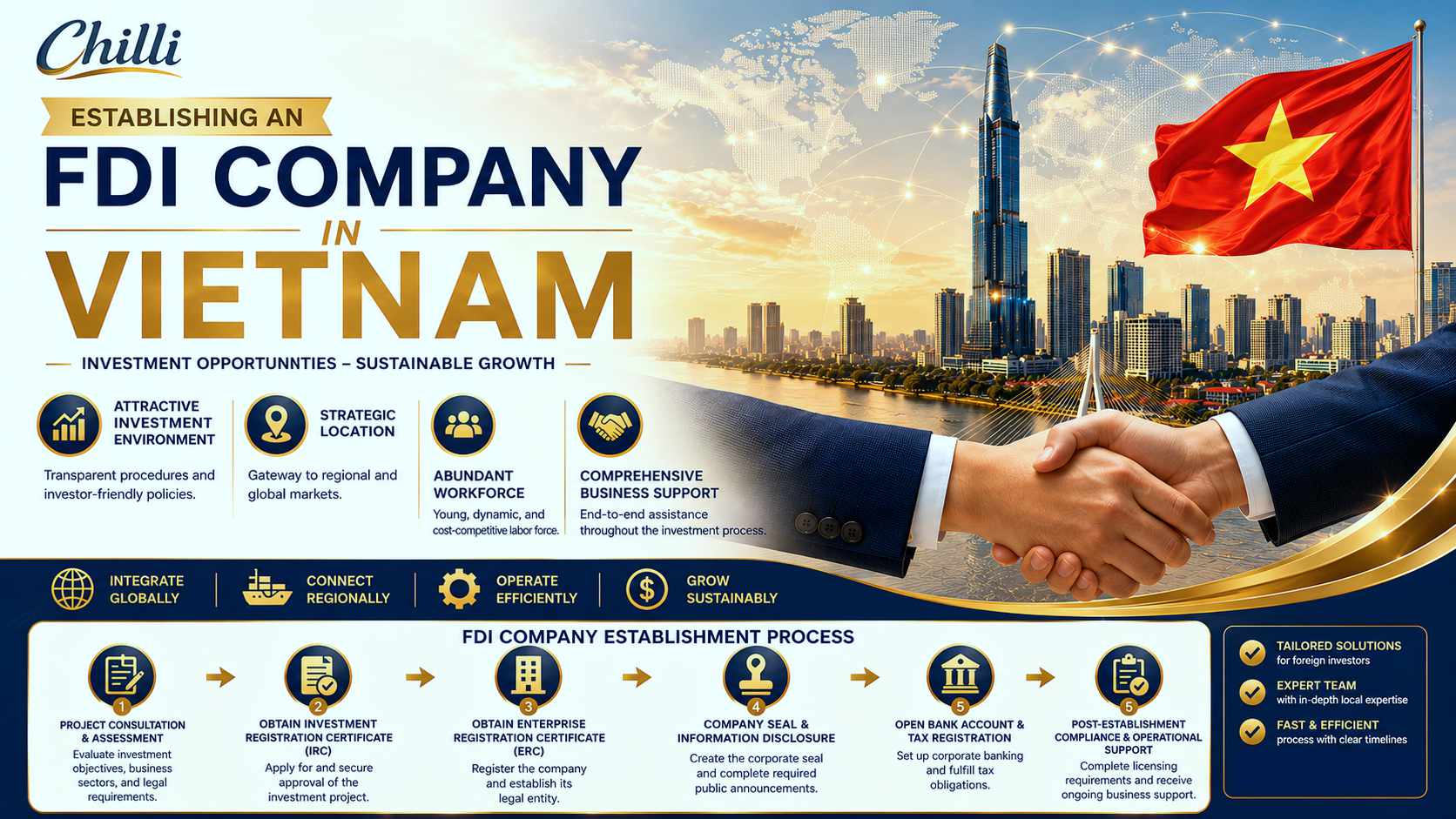
 17/06/2026